Developmental Milestones Chart 0–5 Years: A Clinic Tracking Guide
Short answer: Key developmental milestones to check are: social smile by 6–8 weeks, head control by 3–4 months, rolling over by 4–6 months, sitting without support by 8 months, standing with support by 9–10 months, walking alone by 12–15 months, first words by 12 months, two-word phrases by 24 months, and speaking in sentences by 3 years. Red flags include no social smile by 3 months, not sitting by 9 months, not walking by 18 months, no words by 16 months, and any loss of previously acquired skills at any age, which needs prompt evaluation.
Developmental surveillance is part of every well-child visit, but in a busy OPD it often shrinks to "Is the baby sitting?". Having the median ages and upper limits in front of you, and recording the answer, is what turns a quick question into early detection.
In this guide
- Milestones at a glance
- Red flags that need referral
- Making surveillance stick in a busy OPD
- Frequently asked questions
Milestones at a glance
| Age | Gross motor | Fine motor | Language | Social |
|---|---|---|---|---|
| 6–8 weeks | Lifts head briefly prone | Hands often open | Coos | Social smile |
| 3–4 months | Head control | Hands to midline | Laughs | Recognises mother |
| 6 months | Sits with support, rolls | Palmar grasp, transfers | Babbles (ba, da) | Stranger awareness begins |
| 9 months | Sits alone, stands holding | Immature pincer | Mama/dada non-specific | Waves bye-bye |
| 12 months | Walks with support/alone | Mature pincer | 1–2 meaningful words | Plays simple games |
| 18 months | Runs, climbs stairs holding | Tower of 3 cubes, scribbles | 10+ words | Points to show interest |
| 2 years | Jumps, kicks ball | Tower of 6 | 2-word phrases | Parallel play |
| 3 years | Rides tricycle, stairs alternating feet | Copies circle | Short sentences, asks questions | Knows own gender, shares |
| 4–5 years | Hops, skips | Copies cross/square/triangle | Tells a story | Cooperative play, dresses self |
Ages are approximate medians; normal ranges are wide. Correct for prematurity up to 2 years of age.
Red flags that need referral
- No social smile by 3 months
- No head control by 5 months
- Not sitting without support by 9 months
- Not walking alone by 18 months
- No babbling by 12 months, no words by 16 months, no two-word phrases by 24 months
- No pointing or response to name by 12–15 months (screen for autism, e.g. M-CHAT-R/F at 18–24 months)
- Any regression: loss of speech, social or motor skills at any age
- Persistent hand preference before 18 months, or asymmetric movement
Making surveillance stick in a busy OPD
- Tie it to vaccine visits. The 6-week, 10-week, 14-week, 9-month, 12–15-month and 18-month visits are natural checkpoints.
- Ask the parent first. A short age-specific checklist at intake saves consultation time.
- Record, don't just observe. "Not yet sitting" at 8 months plus "not yet sitting" at 10 months is a pattern only a record shows.
- Screen formally at key ages. Use a validated tool at 9, 18 and 30 months as AAP recommends, or per IAP guidance.
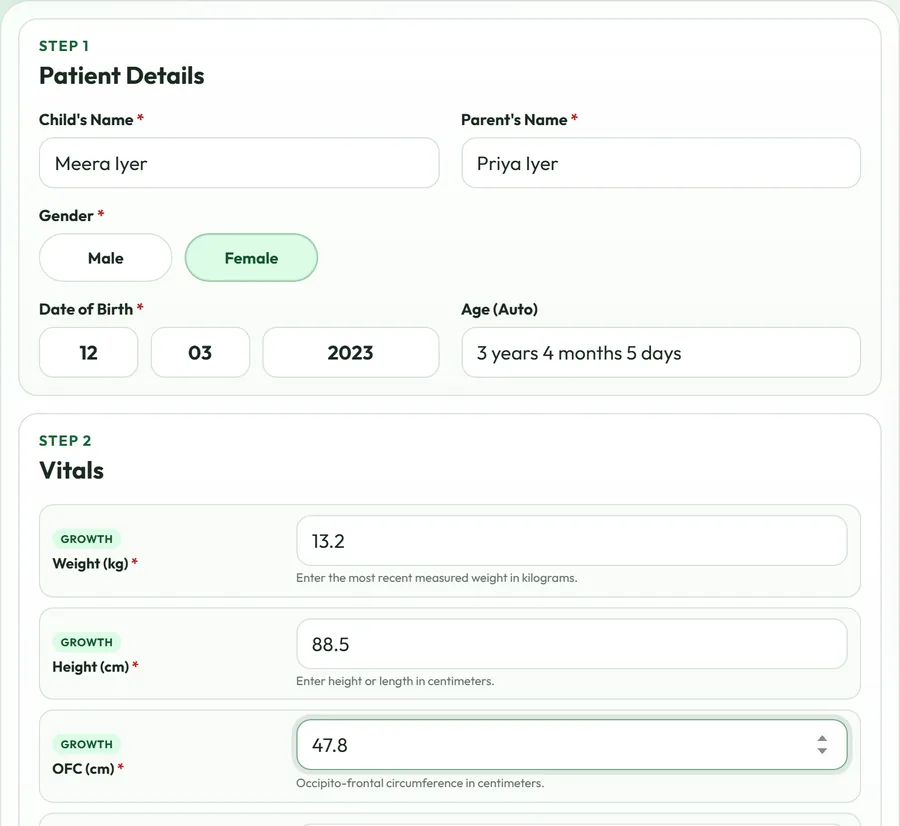
Tie milestone checks to the vaccination schedule and keep the history in one record with PediaNex.
Book a walkthroughFrequently asked questions
At what age should a baby sit without support?
Most babies sit without support by 6–8 months; not sitting independently by 9 months is a red flag that warrants evaluation.
When should a child start walking?
Most children walk independently between 12 and 15 months. Not walking by 18 months should be assessed.
What are red flags in child development?
No social smile by 3 months, not sitting by 9 months, not walking by 18 months, no words by 16 months, no two-word phrases by 24 months, and any loss of previously acquired skills.
Should milestones be corrected for prematurity?
Yes. Use corrected age, calculated from the expected due date, when assessing milestones until about 2 years of age.
Keep growth, vaccines and development in one child record.
Twenty minutes, real workflow, no script. Or start the 15-day free trial.
Book a walkthrough or chat with us on WhatsApp →