ACVIP Immunization Schedule 2026: What It Is and How It Relates to the IAP Schedule
ACVIP (Advisory Committee on Vaccines and Immunization Practices) is the standing committee of the Indian Academy of Pediatrics that researches vaccine evidence and drafts India's pediatric immunization recommendations. The schedule most Indian clinics call the "IAP schedule" is the ACVIP's published output — the two names refer to the same set of recommendations, revised periodically as new vaccines and evidence emerge.
Parents and even some newer clinic staff often search for "ACVIP schedule" and "IAP schedule" as if they're two different things to reconcile. They aren't. Here's what the ACVIP actually does, how its recommendations differ from the government's free schedule, and how clinics keep both straight without confusing families.
What ACVIP actually is
The Advisory Committee on Vaccines and Immunization Practices is a technical committee constituted by the Indian Academy of Pediatrics. Its job is to review published vaccine safety and efficacy data — both global and India-specific — and translate that evidence into a practical immunization schedule that Indian pediatricians can hand to parents. It is not a separate organization from the IAP; it's the body inside the IAP that does this specific work.
When a clinic says "we follow the IAP schedule," that schedule was produced by the ACVIP's review process. The committee also publishes supporting material — including the IAP's immunization handbook — that goes into more depth than the summary schedule most parents see on a clinic wall or app.
ACVIP schedule vs. the government's UIP schedule
India actually has two schedules in common use, and this is the comparison that matters more than "ACVIP vs IAP":
| Schedule | Published by | Cost to family | Coverage |
|---|---|---|---|
| UIP (Universal Immunization Programme) | Government of India, Ministry of Health | Free, at government centres | Core vaccines against 12 diseases |
| ACVIP / IAP schedule | Indian Academy of Pediatrics (ACVIP committee) | Paid, at private clinics | UIP vaccines plus additional recommended vaccines (e.g. certain combination and newer vaccines) |
Why the schedule changes between years
The ACVIP doesn't rewrite the schedule every year, but it does revise it periodically — reflected in year-labelled versions like "2026 schedule." Typical reasons a revision happens:
- New vaccines becoming available in the Indian market that the committee has reviewed and now recommends.
- Combination vaccines replacing what used to be given as separate injections, changing the number of visits needed at a given age.
- Updated dosing intervals based on newer safety or efficacy data.
- Catch-up guidance changes for children who started the schedule late or missed doses.
This is also why a schedule printed and laminated a few years ago can quietly go out of date — a clinic relying on a static printout rather than a tracked, updatable schedule risks giving parents outdated guidance without realizing it.
See the full age-by-age IAP schedule broken down by dose.
Read the complete schedule guideHow clinics keep ACVIP-schedule tracking accurate
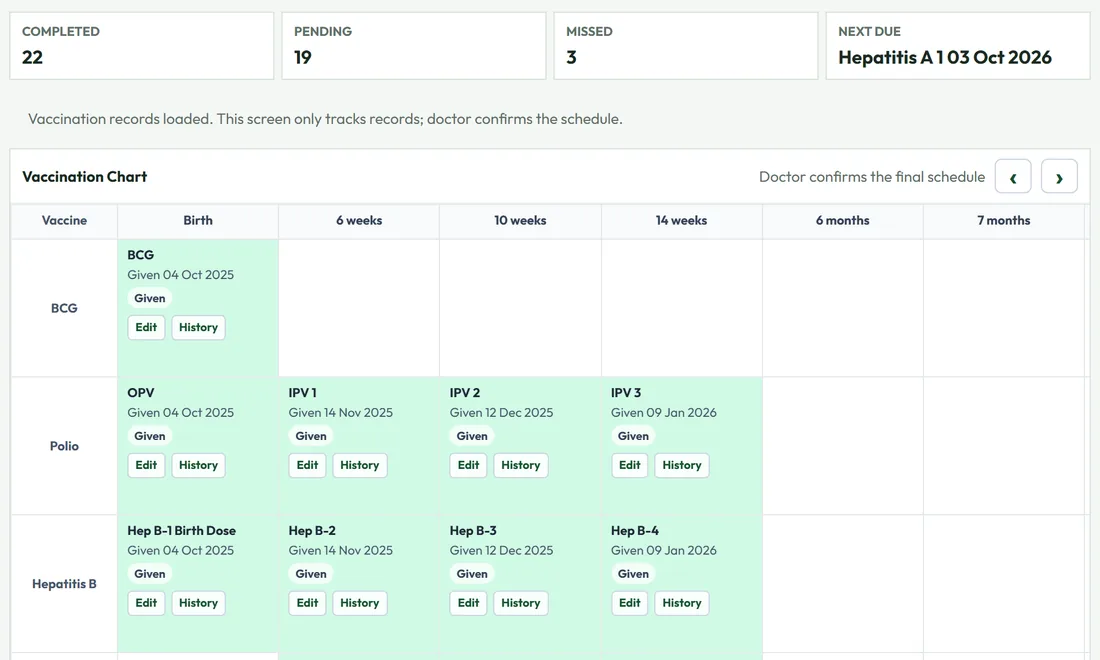
The practical challenge isn't understanding the ACVIP — it's making sure every child's record reflects the current schedule version and flags what's actually due, rather than relying on a receptionist's memory or a wall chart. Clinics that track this digitally get three things a paper system can't:
- Automatic due-date calculation per child, based on date of birth, rather than a generic age-based wall chart.
- Overdue flags the moment a child misses a scheduled window, instead of discovering it at the next visit.
- One place to update when the schedule itself revises, instead of re-printing charts across every consult room.
Frequently asked questions
What does ACVIP stand for?
ACVIP stands for the Advisory Committee on Vaccines and Immunization Practices, a standing committee of the Indian Academy of Pediatrics (IAP) that reviews vaccine evidence and publishes India's pediatric immunization recommendations.
Is the ACVIP schedule different from the IAP schedule?
No — they are the same schedule. The ACVIP is the IAP committee that researches and drafts the recommendations; what clinics call the "IAP schedule" is the output of the ACVIP's review process, published and revised roughly every few years.
How often is the ACVIP schedule updated?
The ACVIP reviews and revises its recommendations periodically as new vaccine evidence, combination vaccines, or safety data become available, and publishes updates through IAP's official channels and its immunization handbook.
Should a clinic follow ACVIP or the Government of India's Universal Immunization Programme (UIP)?
Both schedules are valid and mostly overlap. The UIP is the free, government-run schedule available at public health centres, while the ACVIP/IAP schedule additionally recommends some vaccines not yet part of the UIP. Most private pediatric clinics in India counsel parents using the ACVIP/IAP schedule and note which doses are UIP-covered.
Track every child's ACVIP/IAP schedule automatically — no wall chart required.
Twenty minutes, real workflow, no script.
Book a walkthrough or chat with us on WhatsApp →